Free Case Evaluation
 Contact Us 24/7

Maryland Nursing Home Lawyer

Your Dedicated Attorney
Our Maryland nursing home lawyer is here for you if a loved one has suffered at the hands of those responsible for taking care of them. When people place their parents into a nursing home, they trust that their elders will be taken care of. Unfortunately, this does not always happen. There have been many cases of nursing home neglect in recent years. This occurs when a patient does not receive the level of physical or emotional care they need. If your parent is a victim of nursing home neglect, it’s important to take action and protect them. At Brown Kiely LLP, we offer family members a free consultation with a nursing home lawyer from our staff. Contact us today if you suspect or know that your loved one has suffered abuse by a caregiver.
Types Of Nursing Home Cases We Handle
 At BrownKielyLaw.com, the firm represents individuals and families affected by unsafe conditions and inadequate care in nursing facilities. Our firm brings years of litigation experience to cases involving elder neglect, abuse, and preventable injury in long-term care facilities across Maryland and the surrounding region. Work in this area includes investigating medical records, interviewing witnesses, reviewing facility policies, and working with medical professionals to show how care failures occurred. These efforts are aimed at holding facilities and their insurers accountable when residents are put at risk. That focused approach has made the firm a strong advocate for families seeking answers and financial recovery through our Maryland nursing home lawyer.
Physical Abuse Claims
Physical abuse cases involve harm caused by staff members, caregivers, or even other residents when proper supervision is not provided. These matters often center on bruises, fractures, or unexplained injuries that point to unsafe or aggressive behavior inside a facility.
Emotional And Psychological Harm
Emotional abuse includes threats, humiliation, isolation, or intimidation that causes mental distress to a resident. Even without visible injuries, this type of harm can seriously affect a person’s quality of life and often supports claims brought by a nursing home neglect attorney.
Neglect And Failure To Provide Care
Neglect cases focus on what a facility failed to do, such as not providing meals, hydration, hygiene, or basic supervision. In the third paragraph of this section, families often turn to our Maryland nursing home lawyer when repeated lapses in care lead to serious medical decline or avoidable injury.
Medication Errors
Medication error claims involve situations where staff administer the incorrect drug, provide an improper dosage, or miss a scheduled medication. These mistakes can lead to severe side effects, hospitalizations, or worsening of existing health conditions.
Falls And Mobility Injuries
Falls are one of the most common and dangerous events in nursing homes, often caused by poor supervision or unsafe room layouts. Our long-term care injury lawyer may be involved when a resident suffers broken bones, head trauma, or long-term disability from a fall.
Pressure Sores And Bedsores
Pressure sores develop when residents are not repositioned or cared for properly while in bed or a wheelchair. These wounds can become infected and are widely recognized as signs of neglect within long-term care settings.
Dehydration And Malnutrition
Claims related to dehydration and malnutrition focus on staff failing to monitor food and fluid intake. This type of neglect weakens the immune system and can trigger serious medical complications that could have been prevented.
Infections And Poor Hygiene
Infection cases often stem from unsanitary conditions, untreated wounds, or lack of proper handwashing and cleaning procedures. Families may seek help from a nursing home abuse attorney when infections spread due to these basic care failures.
Wrongful Death In A Nursing Facility
Wrongful death cases arise when a resident passes away because of abuse, neglect, or unsafe conditions. These claims allow families to pursue financial recovery for funeral costs, loss of companionship, and the harm caused by a facility’s conduct.
Holding Nursing Homes Accountable For Resident Harm
Maryland nursing home lawyer services are often needed when families discover that a loved one has suffered harm in a facility that was supposed to provide safety and care. Brown Kiely LLP handles a wide range of nursing home abuse and neglect cases, using detailed investigation and litigation skills to pursue compensation and accountability for injured residents and their families. When concerns arise, taking prompt action helps protect a loved one’s rights and secure key evidence. Those who believe a nursing home failed to meet basic standards are encouraged to reach out to discuss their situation, review available legal options, and take steps toward holding the facility responsible.
Common Signs Of Nursing Home Abuse
Understanding the overarching types of abuse can help you catch signs of said abuse. That’s probably why you invested in a nursing home, and you want to know they’re safe and being cared for. If you’ve noticed signs of nursing home abuse, reach out to a nursing home abuse lawyer.
Though this is not an all-inclusive list, here are five common signs of nursing home neglect:
Malnutrition
Malnutrition can result from nursing home neglect. Whether it is caused on purpose or from lack of proper oversight of the resident, poor nutrition can seriously affect their long term and short term health. Common signs of malnutrition include weight loss, lethargy, poor concentration, and a loss of appetite. If you believe your elderly loved one has suffered malnutrition in a nursing home, contact a lawyer from Brown Kiely LLP without delay.
A nursing home lawyer Montgomery County victims rely on can help you file a claim or lawsuit against those responsible. A settlement or jury award can make all the difference when it comes to making sure your loved one has the funds necessary to get the medical care they need.
Poor Hygiene
Many nursing home residents rely on staff members to help them brush their teeth, take baths, cut their nails, and brush their hair. If staff members neglect to do this, residents’ personal hygiene may suffer. If you notice that your parent looks unkempt or smells bad, it’s likely that his or her personal hygiene needs aren’t being met. This can result in serious skin afflictions and other health concerns.
Unexplained Injuries
Nursing home residents who do not receive the proper care are in danger of suffering injuries. For example, if there is not a nurse available to help a resident walk to the bathroom, he or she may slip and fall and get hurt. If your elderly loved one has suffered bruises, broken bones, or other injuries, he or she probably isn’t getting the attention they need and deserve at the nursing home. When someone is advanced in age, a broken bone can be a very serious health concern and in some cases, can lead to death. It’s important to be proactive by consulting a nursing home lawyer Montgomery County loved ones choose for their elders who may not have a voice regarding their care.
Lack Of Mobility
It is important for nursing home residents to exercise and move around frequently to strengthen their bones. Mobility is also necessary to keep their circulation healthy by delivering oxygen-rich blood to their brain and organs. If residents are left in bed for too many hours in a day, it can reduce their mobility and even put them at risk of infections and bedsores. It can also lead to depression. Depression can lead to a loss of appetite and adversely affect their physical and emotional health.
If your parent has sudden mobility issues, it could be a cause for concern. For that reason, it may be important to follow up with the nursing home staff to find out how much exercise your loved one is receiving. You may also wish to speak directly with the facility’s physician to look into your parent’s health concerns.
Unclean Living Conditions
Nursing homes have a responsibility to ensure their living spaces and common areas are safe and clean for their residents. If they fail to do this, the residents can catch serious illnesses. It can also be detrimental to their state of mind to live in an unkempt living facility. When you visit your parents in the nursing home, be sure to check out the living conditions. Does he or she have a bed with fresh sheets? Are the bathroom and kitchen clean? If the nursing home appears to be unsanitary, disorganized, or dirty in some way, you may want to speak to a knowledgeable lawyer from Brown Kiely LLP.
At Brown Kiely LLP, we know how devastating it can be to find out your loved one is the victim of nursing home neglect. We have helped many people in your situation obtain compensation from those responsible so that their loved ones could get the care they need. Our lawyers can help you file an injury claim or a lawsuit against the nursing home for your loved one’s mistreatment.
The Four Steps Of A Nursing Home Abuse Lawsuit
If you recently received news that your senior loved one has endured nursing home mistreatment, you can rely on us. We have been committed to protecting the health and wellbeing of people since 1998. Our team can offer experience and empathy when it comes to helping you take legal action against the facility responsible for this abuse or neglect. You may have already filed a report with the nursing home facility regarding these incidents of mistreatment. You may have found that the response you received was less than satisfactory, and are now interested in taking further action.
Finding out that the nursing facility is not going to properly address the allegation of resident mistreatment can be incredibly upsetting. You may then feel increasingly motivated to see that justice and compensation is sought. If there is a solid foundation for a lawsuit, then your lawyer at Brown Kiely LLP can help you prepare for the legal proceeding to come. In general, there are four steps involved when undertaking a lawsuit. These steps can include the following:
Gathering Information About The Allegation
Talk with your loved one about all the times he or she was left unattended to, physically harmed, felt threatened, or otherwise treated in an unsafe manner. You may realize that there were more situations than he or she had initially informed you of. Sometimes, it takes a victim of nursing home mistreatment a long time to finally speak up about what is going on. Your loved one may have feared worsened abuse, or that he or she would not be believed anyway.
Completing Necessary Paperwork
Filing a nursing home abuse lawsuit with the courts in the appropriate Maryland jurisdiction and waiting for the facility to receive notice of the legal action being taken. Your nursing home lawyer can oversee your completion of the paperwork to notify you of errors or statements that could potentially have a negative impact on the case.
Assembling Information For Discovery
Your nursing home lawyer can help you collect, organize and make copies of information that can be supportive to the case. The more details and proof you can bring forward regarding the mistreatment, the more likely you can get the settlement you are hoping for. Impactful evidence can include your loved one’s statements of the abuse, photographs of visible injuries, and witnesses who saw the incident happen.
Negotiation Of Settlement And Trial
In most civil cases, rarely does it proceed forward to a court trial. What is likely to happen is a settlement is reached, where all parties involved are satisfied with the resolution. However, if you are not pleased with the settlement, then you can move forward to a trial where a judge and/or jury decide the outcome instead.
If you are worried about the safety of your loved one in a nursing home, we suggest reaching out to us right away. Please call us today for a free consultation with a nursing home lawyer clients recommend at Brown Kiely LLP. We can help you decide whether legal action may need to be taken regarding the mistreatment.
Collecting Evidence For A Nursing Home Abuse Case
If you plan on working with a nursing home lawyer in Maryland to file an elder abuse lawsuit, you’ll want to make sure you gather evidence to support your case. Depending on the type of abuse your loved one has experienced, there are different ways to collect the necessary proof.
Evidence For Physical Abuse
This type of abuse is usually relatively easy to gather proof of. Take pictures of the injuries your family member sustained and, if possible, document their account of what happened. Any witnesses to the incident will be helpful in corroborating your loved one’s version of events, so ask for statements from anyone who saw what happened. You should also obtain a copy of the incident report, which should have been filed at the time of the injury. If one was not filed, this may be a red flag and the absence of a report is also evidence.
An experienced nursing home lawyer in Maryland, like the attorneys at Brown Kiely, LLP, can help guide you through what information should be gathered and how to obtain it. A medical report and a doctor’s statement regarding how the injury could have been caused may also prove useful. Having your loved one evaluated by a medical professional will, at the very least, provide a timestamp for the status of the injuries.
Evidence For Neglect
While neglect can cause physical harm, there are often invisible effects of this type of abuse. Due to the nature of the injuries it causes, neglect can be more difficult to prove. A nursing home lawyer in Maryland can tell you what will be needed to move forward with your case. A psychological evaluation of emotional damages, as well as a physical examination done by a physician, offers an account of your loved one’s wellbeing. You can also take pictures of anything troubling you see, such as broken walkers, dirty living areas, or any other unsafe conditions.
Regardless of the type of abuse, there are some general guidelines for collecting the evidence you will need for a lawsuit. Document any conversations you have with staff and keep notes on your family member’s condition. Record any concerns you have and include your elder’s concerns, as well. Photographic evidence can be very helpful as a visual representation of the abuse.
If your loved one has experienced these or any other types of abuse, contact the caring and diligent lawyers at Brown Kiely, LLP.
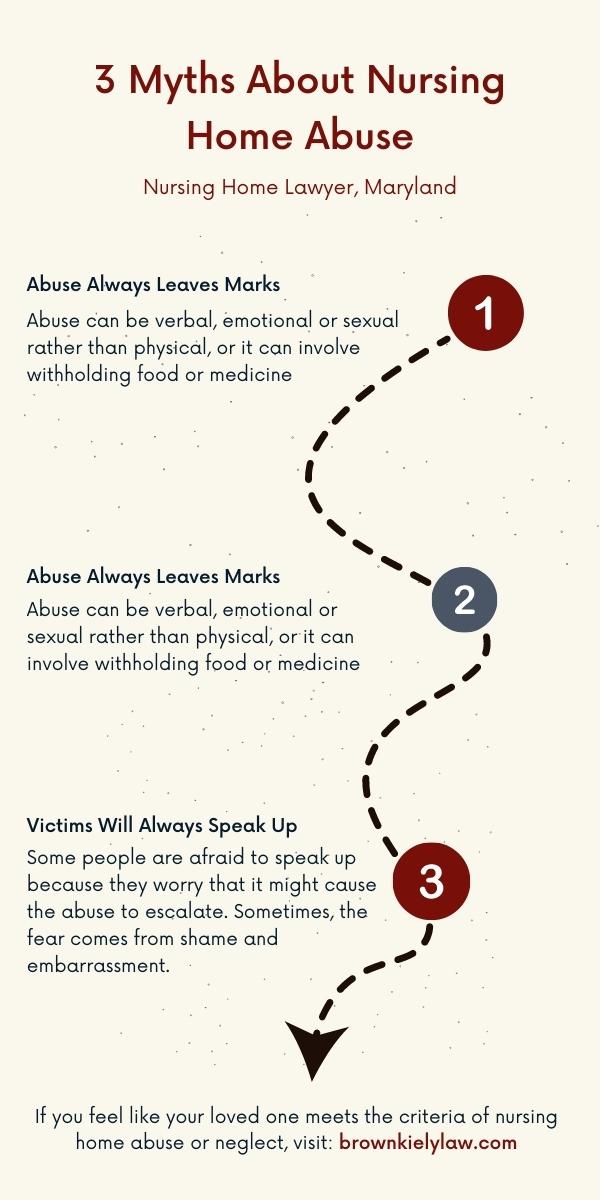
Maryland Nursing Home Infographic
Maryland Nursing Home Abuse Statistics
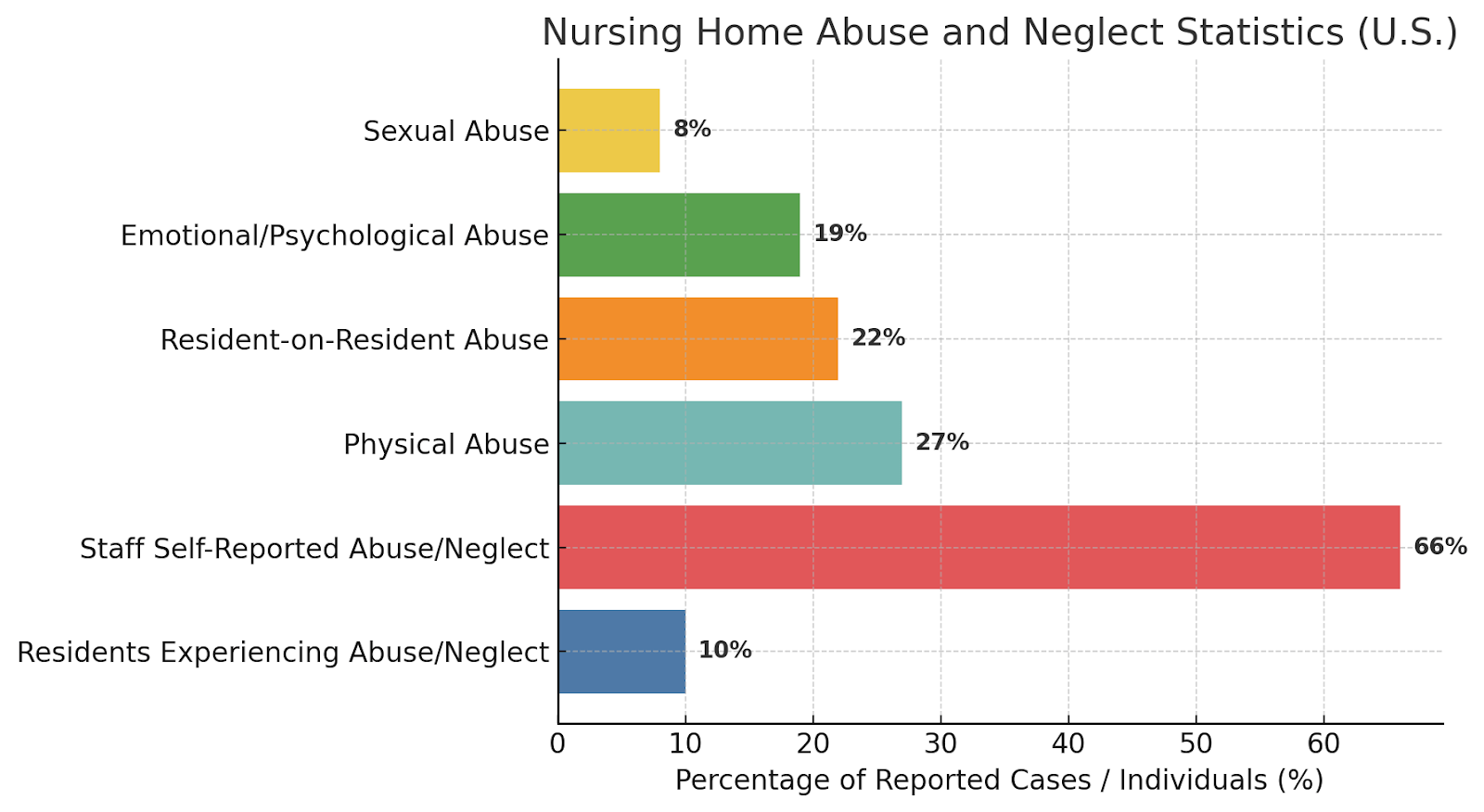
Abuse and neglect in nursing homes present a serious and often hidden threat to vulnerable older adults. Estimates suggest that approximately 10% of residents in long-term care facilities experience some form of abuse or neglect. In the United States, reports indicate that a significant portion of nursing home staff admit to committing abusive or neglectful acts, with some studies showing that over 66% of staff self-reported having engaged in such behavior.
Beyond physical abuse, other forms such as emotional/psychological abuse, resident-on-resident incidents, sexual abuse, financial exploitation, and neglect of basic needs have been documented. One breakdown of abuse types in care facilities found that physical abuse accounted for around 27% of incidents, resident-on-resident abuse about 22 %, emotional abuse nearly 19%, and sexual abuse approximately 8%.
Nursing home abuse is just one type of elder abuse, and it’s very hard to get accurate numbers because not every elderly person wants to admit they’re being abused. The National Council on Aging, or the NCOA, has worked with the World Health Organization (WHO) and the National Center on Elder Abuse (NCEA) to get statistics that may help you better understand nursing home abuse.
- The above organizations have found that women are more likely to be abused than men, lower socioeconomic status can lead to elder abuse, and individuals who have past trauma in their lives are more likely to be abused again. Mental health and physical health can play into the likelihood of being abused, too.
- The NCOA found that roughly 6 out of every 10 elder abuse cases were caused by family members, and in 2020 the WHO found through a study that roughly 64% of nursing home staff members were committing some form of abuse towards their patients.
- Environments that can worsen abuse are another factor to take into mind, such as social isolation where the elderly have no family or friends who visit, poor-quality nursing homes that are lacking in facilities and resources, and household size. The more people in a household, the greater the risk of abuse.
- When you look at the four types of abuse: emotional, sexual, financial and physical, the above organizations were able to get some stats regarding those as well. Keep in mind, these stats are skewed as not every case is reported.
- When it comes to physical nursing home abuse, the studies found that roughly 24% of residents would experience one instance of physical abuse while in the nursing home. This could be as simple as being pushed down, left in bed or in a chair all day, or other signs of physical abuse.
- Emotional abuse is the most prevalent type reported by nursing home staff members in 2020, according to the WHO. Almost 1 out of every 3 staff members admitted to emotionally abusing their patients. Emotional abuse is screaming at patients, or otherwise denying their emotional needs, even isolating patients falls into this category of abuse.
- Furthermore, verbal abuse is the most often reported elder mistreatment when it comes to family members committing abuse. Verbal abuse goes hand-in-hand with emotional abuse, but does have its own category. This is screaming at patients, calling them names or otherwise verbally bullying them.
- Sexual abuse was the least commonly reported, as the WHO found that less than 2% of nursing home residents reported cases. Sexual abuse is the least commonly reported, but this does not mean that it happens the least. People in these situations are least likely to report, especially if they are a man being sexually abused by a woman, or an older man, younger woman. In generally, elderly people want to hide this type of abuse because they usually talk themselves into being ashamed, and feeling at fault as do many victims of sexual abuse.
- Financial abuse happens if an individual’s finances are exploited or withheld from them. Elders are most likely to experience this form of abuse, especially elders who have dementia and other issues remembering things. 1 in 20 older adults indicated that they suffered from financial abuse.
Maryland Nursing Home Abuse Statistics
According to the National Council on Aging (NCOA), as many as 5 million older Americans experience abuse every year, many of them residing in nursing facilities. One study estimated that only one in 24 cases of abuse are reported to authorities. Elders who have been abused have a 300% higher risk of death when compared to those who have not been mistreated. Contact a nursing home lawyer to find out what signs you should be looking for if you suspect your elderly loved one is a victim.
Nursing Home Abuse FAQs
Who is most likely to inflict abuse on a senior resident?
Doctors, nurses, care staff, other residents, and visitors may be perpetrators of nursing home abuse. Anyone who has access to the senior person’s room or common areas could inflict harm. Abusive behavior can entail unintentional or intentional acts that leave the victim with trauma, injury, or death. Incidents of abuse are commonly the result of poor training, lack of staff, and burnout. However, this is no excuse for harmful behavior against senior citizens, and you must call our MD nursing home lawyer if you think it may be happening to your relative.
What are signs that nursing home abuse is happening?
Abuse is defined as any kind of behavior that includes mental/emotional abuse, physical assault, sexual assault, or neglect. If you suspect this is happening to your loved one, it is imperative that you take action quickly with support from a reputable law firm, such as Brown Kiely, LLP. Examples of common symptoms of nursing home mistreatment are listed as follows:
- Living in unkempt conditions
- Withdrawn and not communicative
- Refusing to be helped by specific staff member or doctor
- Malnutrition
- Dehydration
- Bedsores
- Infections
- Fall injuries
- Unexplained injuries
- Emotional outbursts
- Isolating from family
What are the signs of abuse?
If there are any changes to an elderly person’s personality, mood, or behavior, then there is enough reason to consider that abuse may be happening. Abuse can be mental, physical, or financial. Caretakers, doctors, and other staff may be the culprits of mistreatment. Common signs of elderly abuse include but are not limited to:
- Unexplained injuries
- Scars, welts, or bruising on body
- Not taking medications properly
- Broken glasses
- Restraint marks on wrists or ankles
- Refusing to be alone with a certain caregiver
- Odd or self-sooth behaviors such a rocking or mumbling
- Bruising around breasts or genitals
- Torn, bloody, or stained underwear
- Anal or vaginal bleeding (not related to medical condition)
- Sudden changes in finances or use of money
- ATM withdrawals or purchases the elderly person could not have done
- Missing items or cash from room
- Sudden changes in life insurance, will, titles, power of attorney, etc.
Who is most likely to inflict abuse?
If a senior person is staying at a nursing home, then the doctors, medical staff, caregivers, or other residents may be perpetrators of the abuse. But if the elderly relative lives in someone else’s home, then it may be close friends or family members who are unable to provide the care needed. Elder abuse is more likely to occur if a caregiver has depression, perceives little rewards in caring for the elderly, cannot cope with stress of caring for another, or doesn’t have support from others.
Abuse Vs. Neglect
No matter the situation, your loved one does not deserve to be abused or neglected, and you may need to take matters into your own hands right away. There can be a fine line in between what is deemed abuse and what is deemed disregard of clients in nursing homes. For further information call a nursing home lawyer from Brown Kiely, LLP today for a free consultation.
Examples Of Abuse
- Hitting
- Slapping
- Pressing
- Striking with things
- Hazards
- Harassment
- Shouting in anger
- Physical or chemical (use of medications) restraints
- Sexual assault (from rape to unwanted touching).
Examples Of Neglect
- Not changing clothes when they are wet or after an episode.
- Not supplying oral/dental care.
- Not giving residents routine baths.
- Not providing jobs or activities to locals who want to preserve their self-reliance.
- Not administering medication when needed or offering appropriate wound care.
- Not setting up toileting or helping residents when they ask.
- Not keeping residents fed or hydrated.
- Not responding to a resident’s call for help or help.
Assisted living home neglect may be more challenging to identify than abuse in some circumstances. Instances of neglect are common in U.S. nursing homes.
Facts About Emotional Elder Abuse
Not all kinds of nursing home abuse are easy to spot. In some instances, the abuse is insidious and subtle in nature. Emotional abuse in particular may be happening without any physical signs of mistreatment. However, it can still cause so much damage to the victim’s wellbeing and safety. If you suspect that your senior loved one is suffering from elder abuse, we strongly encourage you to get in touch with our law office now for advice on what to do next.
Because the senior victims of mental abuse are commonly intimidated or threatened to remain silent, it’s important for families to know the signs of potential emotional mistreatment. Signs that elder abuse may include one or more of the following:
- Resident engages in self-harming behavior
- Resident avoids eye contact with specific caregivers
- Residents has withdrawn from talking to or accepting visits from family
- Resident is exhibiting symptoms of anxiety or depression
- Resident is shyer than they were before, and other personality changes
- Resident has emotional outbursts without known cause
Emotional abuse occurs when a volunteer, other resident, caregiver, doctor, or staff member inflicts psychological harm. Frequently seen forms of elder abuse are:
- Blaming the resident for things they did not do
- Ridiculing or humiliating a resident
- Isolating a resident from socializing activities
- Ignoring the resident completely
As the relative of someone in a nursing home facility, it’s imperative that you monitor their health and take action immediately upon witnessing or suspecting abuse happening. We can intervene to ensure the safety of your relative and that the offenders are held accountable to the fullest extent of the law. We are not afraid to fight relentlessly for our clients, because no one deserves to be abused in the place they call home, or anywhere for that matter. Don’t hesitate to call our law firm even if you just need a few questions answered. You can trust we are on your side.

Nursing Home Lawyer Glossary
As an experienced Maryland nursing home lawyer, we speak daily with families trying to protect the safety and dignity of loved ones in care facilities. The legal process can feel overwhelming, especially when unfamiliar terms surface during conversations or legal filings. That’s why we’ve compiled this glossary—to explain several of the most relevant terms and phrases you may encounter when dealing with elder mistreatment in a nursing home. This resource can help you better understand how a case may be evaluated and what your next steps could look like.
Care Plan Noncompliance
Every nursing home resident has an individualized care plan, which outlines the specific physical, medical, dietary, and emotional support they need. This plan is created by a team of professionals including nurses, physicians, dietitians, and sometimes therapists. If a facility fails to follow that plan—for example, by skipping scheduled medication doses, not providing required mobility assistance, or ignoring dietary limits—this is considered care plan noncompliance.
In legal cases, this is a critical point of analysis. Failing to follow a care plan isn’t just poor practice—it could lead to preventable harm. If there’s a pattern of ignoring key components of a resident’s care, it could indicate a serious breach in responsibility, and may serve as part of the legal basis for a formal complaint.
Staff-to-Resident Ratio
The staff-to-resident ratio refers to how many caregivers or aides are available to serve the residents at any given time. Although nursing homes are required to meet certain minimum ratios under federal and state law, maintaining only the bare minimum can still leave residents vulnerable.
In facilities with a low staff-to-resident ratio, caregivers are often rushed or distracted, which can result in missed medications, delayed assistance, or even dangerous conditions such as falls. This ratio is commonly reviewed in cases where residents suffer from preventable incidents. If a caregiver is responsible for too many individuals, it may reflect systemic issues that affect the overall quality of care.
Resident Rights Violation
Federal law grants nursing home residents a broad range of protections that must be upheld by every care facility. These include the right to privacy, the right to participate in one’s own medical decisions, freedom from abuse, and the right to communicate with family. Violating any of these can have legal consequences.
Some common examples include restricting phone access, denying visits from family members, ignoring requests for care changes, or using restraints inappropriately. When these rights are violated, a nursing home may face penalties, investigations, or lawsuits depending on the severity and impact of the situation.
Unexplained Injuries Documentation
Any time a resident is injured—whether it’s a bruise, broken bone, or other physical mark—there should be proper documentation filed by the facility. If an injury occurs without a clear explanation or if the account provided does not align with the medical evidence, this can be a red flag.
Photos, witness statements, and medical assessments can be used to compare with the nursing home’s incident reports. If injuries go undocumented or appear frequently with vague explanations, this may indicate neglect or abuse. Documentation (or the lack thereof) is a core piece of evidence in many elder mistreatment claims.
Inadequate Supervision
Supervision in a nursing home setting means more than just watching over residents. It includes assisting with walking, responding to help requests, and monitoring those with cognitive conditions like dementia. When staff fail to monitor residents who are at risk of falling, wandering, or self-harm, the consequences can be serious.
Signs of inadequate supervision often include repeated falls, residents found in unsafe conditions, or missed medical problems that escalate due to inattention. This failure is not always about intent—it often stems from understaffing or poor training—but it still leaves residents at risk and may be cause for legal action.
If your loved one is experiencing any of these issues in a care facility, you don’t have to wait for a crisis to seek help. At Brown Kiely LLP, we have worked with families across Maryland to review care concerns, build strong legal cases, and help hold facilities accountable.
Call today to set up a free consultation with our legal team. We’ll help you assess what actions you can take to protect your family member.
Brown Kiely, LLP, Maryland Nursing Home Lawyer
3 Bethesda Metro Center Suite 700
Bethesda, MD 20814
Contact Us Today
Our nursing home lawyer plays a crucial role in safeguarding the rights and well-being of elderly residents in long-term care facilities. Their expertise in nursing home regulations, elder law, and litigation can be instrumental in seeking justice and compensation for victims of abuse, neglect, medical malpractice, rights violations, and financial exploitation. Families of nursing home residents can find solace knowing that there are legal professionals dedicated to ensuring their loved ones receive the care and respect they deserve in their later years. If you are searching for legal help regarding a nursing home case, contact our skilled attorneys at Brown Kiely, LLP who is ready to offer their quality legal services for you.
Client Review
“I had a case of business contract litigation and Dan Brown was incredibly prompt and efficient. He reviewed the case quickly and made great advices and started working on it right away and with his help the case was closed the way I wanted. I am so glad I found him and I highly recommend him to anyone in need of a good attorney.”
Sara Jafaris Fashami